CD and Arc Stud Welding: What’s the Difference?

by | Feb 23, 2023 | Blog Posts | 0 comments

What Process Should You Use?

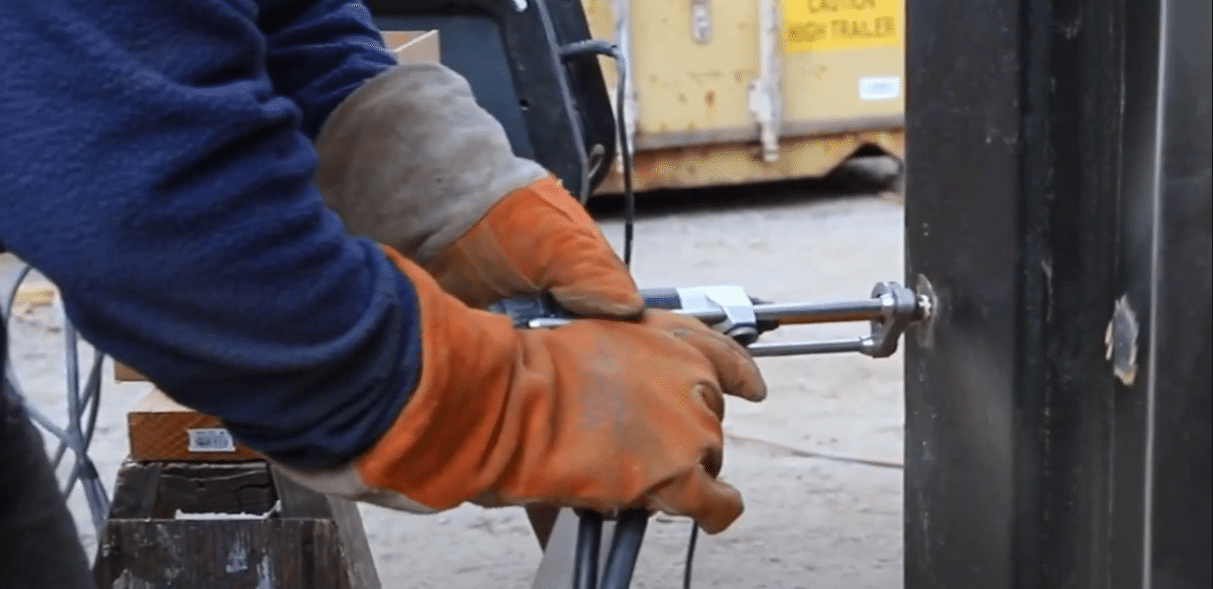
Capacitor Discharge (CD) stud welding is a semi-automatic arc welding process. However, with CD welding, you have the ability to weld small diameter studs to very thin material. The entire weld cycle completes in just a few milliseconds, enabling you to weld thin sheets of metal without causing pronounced distortion, burn through, or discoloration. Additionally, the CD process facilitates stud welding of dissimilar metals.

Commonly used in most sheet metal shops.

On the other hand, Arc stud welding allows almost any size or type of weld stud to be welded. Studs must be manufactured from weldable material and designed with a special arc stud tip. The Arc process produces a full fusion weld that is stronger than the stud itself. You can apply arc stud welding to mild steel, stainless steel, and aluminum.

Commonly used in most fabricating/structural steel shops.

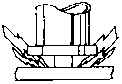
Capacitive Discharge
CD Fastener
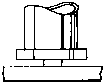
CD Fasteners generally utilize a specially engineered projection or tip at the weld base. It’s design configuration and length provide accurate welding time control, for consistently reproducible results.
CD Fastener Energy Discharge
Banks of low voltage DC electrostatic capacitors, electronically controlled and triggered on demand by the operator, instantaneously discharge energy.
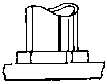
CD Fastener Weld
When you actuate the triggering circuit, it releases the stored energy from the capacitors through the stud. This process vaporizes the high-resistance tip and creates an ionization path, allowing peak current flow and arcing across the areas that need to be joined.
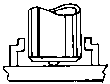
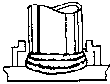
CD Fastener welded to parent metal
The spring or air pressure from the gun fuses the partially melted stud to the parent metal surface, completing the weld in just four to six milliseconds and creating a bond stronger than the fastener itself.

Arc

Arc fastener and ferrule
The weld gun applies the stud fastener firmly to the work surface under spring tension. Arc welding draws its energy from either DC rectifiers or a motor-generator set, while precision timing circuits automatically control the degree and intensity of the process.
Arc fastener energy discharge
The trigger button initiates the cycle which energizes the gun solenoid, lifting the stud from the metal surface and creating an arc which melts a flux-loaded end of the fastener and its immediate area.
Arc fastener bonded to parent metal
A ceramic ferrule shields the arc, concentrates the heat and contains the molten metal in the weld zone. Simultaneously, the gun solenoid becomes de-energized and the spring tension forces the fastener into the molten pool, integrating it with the parent metal.
Arc fastener ferrule removed
The cycle is completed in less than a second and the resulting weld bond develops the full strength of the fastener in the weld zone. The expendable ferrule is broken away to expose a smooth and complete fillet at the stud base.

Length Information

Capacitor Weld Pins are available in 12-GA and 14-GA up to lengths of 6-inches as standard. Special lengths are available upon request.

Capacitor Weld Studs are manufactured in minimum lengths of 1/4-inch up to 2-inch as standard. Other lengths are available upon request.

Capacitor Weld Studs and Pins do not undergo any loss of length after welding.

Arc Studs are available from minimum lengths After Weld (AW) shown on individual specification sheets up to any length in increments of 1/8-inch. Please call one of our service representatives for specification sheets.

All Arc Studs and Pins are reduced approximately 1/8-inch in length after welding for diameters up to 1/2-inch weld base diameter and approximately 3/16-inch for 5/8-inch weld base or larger.

View our Products!

Additionally, click here to view all Capacitive Discharge stud welding systems offered here at Stud Welding Products! Click here to see our Arc welding systems! Have questions? Email us at Info@studweldprod.com or call our office at 800-252-1919 and we will get back to you shortly!

Recent Posts

Centering Tube

Get the Precision and Accuracy You Need with a Centering Tube! Using a Centering Tube, or Template...

WPS/PQR HEADACHES?

LET STUD WELDING PRODUCTS HELP! Let's start with WPS, Weld Procedure Specifications, the main...

What is Stud Welding?

Stud Welding is the process of fastening a weld stud (or “stud”) to a base metal material. The key...

Aluminum Stud Welding

Aluminum Stud Welding Unlock the Power of Stud Welding for Your Next Project! Aluminum stud...

Categories

Find us on social media